
Affichage des articles dont le libellé est Higher Education. Afficher tous les articles

mercredi 5 février 2020

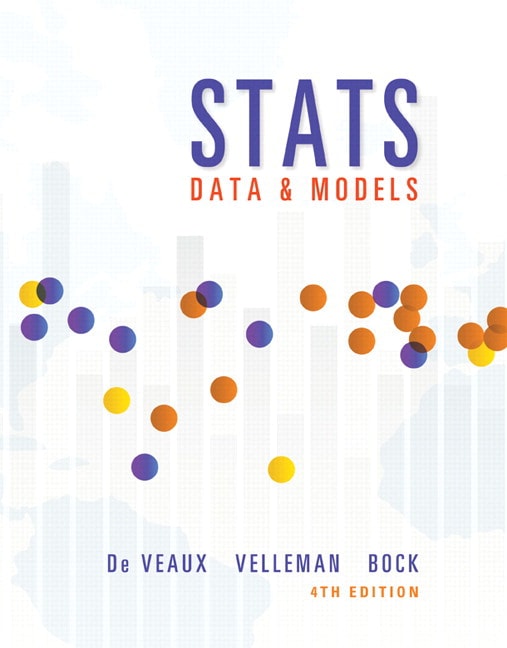
Purchase Stats: Data and Models Plus NEW MyLab Statistics with Pearson eText Package, 4th Edition E-book Online

Stats: Data and Models Plus NEW MyLab Statistics with Pearson eText  Package, 4th Edition

30.00$ - Purchase this E-book 

Digital File Direct & Fast Download (ZIP & PDF)
All chapters are included in the tesst Bank
Free samples included once needed (ZIP & PDF)
Several payment options (Paypal , Credit Card)  - NO account Required
Dedicated support / instant chat – Email - Whatsapp

Category : Higher Education

Table of Contents

Preface

Part I: Exploring and Understanding Data

1. Stats Starts Here

1.1 What Is Statistics?

1.2 Data

1.3 Variables

2. Displaying and Describing Categorical Data

2.1 Summarizing and Displaying a Single Categorical variable

2.2 Exploring the Relationship Between Two Categorical variables

3. Displaying and Summarizing Quantitative Data  

3.1 Displaying quantitative variables  

3.2 Shape  

3.3 Center

3.4 Spread

3.5 Boxplots and 5-Number Summaries

3.6 The Center of Symmetric Distributions: The Mean

3.7 The Spread of Symmetric Distributions: The Standard Deviation

3.8 Summary—What to Tell About a quantitative variable

4. Understanding and Comparing Distributions

4.1 Comparing Groups with Histograms

4.2 Comparing Groups with Boxplots

4.3 Outliers

4.4 Timeplots: Order, Please!

4.5 Re-Expressing Data: A First Look

5. The Standard Deviation as a Ruler and the Normal Model

5.1 Standardizing with z-Scores

5.2 Shifting and Scaling

5.3 Normal Models

5.4 Finding Normal Percentiles

5.5 Normal Probability Plots

Part II: Exploring Relationships Between Variables

6. Scatterplots, Association, and Correlation  

6.1 Scatterplots

6.2 Correlation

6.3 Warning: Correlation ≠ Causation

6.4 Straightening Scatterplots

7. Linear Regression

7.1 Least Squares: The Line of “Best Fit”

7.2 The Linear Model

7.3 Finding the Least Squares Line

7.4 Regression to the Mean

7.5 Examining the Residuals

7.6 R2—The variation Accounted For by the Model

7.7 Regression Assumptions and Conditions

8. Regression Wisdom

8.1 Examining Residuals

8.2 Extrapolation: Reaching Beyond the Data

8.3 Outliers, Leverage, and Influence

8.4 Lurking variables and Causation

8.5 Working with Summary values

9. Re-expressing Data: Get It Straight!

9.1 Straightening Scatterplots – The Four Goals

9.2 Finding a Good Re-Expression

Part III: Gathering Data

10. Understanding Randomness

10.1 What Is Randomness?

10.2 Simulating by Hand

11. Sample Surveys

11.1 The Three Big Ideas of Sampling

11.2 Populations and Parameters

11.3 Simple Random Samples

11.4 Other Sampling Designs

11.5 From the Population to the Sample: You Can’t Always Get What You Want

11.6 The valid Survey

11.7 Common Sampling Mistakes, or How to Sample Badly

12. Experiments and Observational Studies

12.1 Observational Studies

12.2 Randomized, Comparative Experiments

12.3 The Four Principles of Experimental Design

12.4 Control Treatments

12.5 Blocking

12.6 Confounding

Part IV: Randomness and Probability

13. From Randomness to Probability

13.1 Random Phenomena

13.2 Modeling Probability

13.3 Formal Probability

14. Probability Rules!

14.1 The General Addition Rule

14.2 Conditional Probability and the General Multiplication Rule

14.3 Independence

14.4 Picturing Probability: Tables, Venn Diagrams, and Trees

14.5 Reversing the Conditioning and Bayes’ Rule

15. Random Variables

15.1 Center: The Expected value

15.2 Spread: The Standard Deviation

15.3 Shifting and Combining Random variables

15.4 Continuous Random variables

16. Probability Models

16.1 Bernoulli Trials

16.2 The Geometric Model

16.3 The Binomial Model

16.4 Approximating the Binomial with a Normal Model

16.5 The Continuity Correction

16.6 The Poisson Model

16.7 Other Continuous Random Variables: The Uniform and the Exponential

Part V: From the Data at Hand to the World at Large

17. Sampling Distribution Models

17.1 Sampling Distribution of a Proportion

17.2 When Does the Normal Model Work? Assumptions and Conditions

17.3 The Sampling Distribution of Other Statistics

17.4 The Central Limit Theorem: The Fundamental Theorem of Statistics  

17.5 Sampling Distributions: A Summary

18. Confidence Intervals for Proportions

18.1 A Confidence Interval

18.2 Interpreting Confidence Intervals: What Does 95% Confidence Really Mean?

18.3 Margin of Error: Certainty vs. Precision  

18.4 Assumptions and Conditions

19. Testing Hypotheses About Proportions

19.1 Hypotheses

19.2 P-values

19.3 The Reasoning of Hypothesis Testing

19.4 Alternative Alternatives

19.5 P-values and Decisions: What to Tell About a Hypothesis Test

20. Inferences About Means

20.1 Getting Started: The Central Limit Theorem (Again)

20.2 Gosset’s t

20.3 Interpreting Confidence Intervals

20.4 A Hypothesis Test for the Mean

20.5 Choosing the Sample Size

21. More About Tests and Intervals

21.1 Choosing Hypotheses  

21.2 How to Think About P-values

21.3 Alpha Levels  

21.4 Critical values for Hypothesis Tests

21.5 Errors

Part VI: Accessing Associations Between Variables

22. Comparing Groups

22.1 The Standard Deviation of a Difference

22.2 Assumptions and Conditions for Comparing Proportions

22.3 A Confidence Interval for the Difference Between Two Proportions

22.4 The Two Sample z-Test: Testing for the Difference Between Proportions

22.5 A Confidence Interval for the Difference Between Two Means  

22.6 The Two-Sample t-Test: Testing for the Difference Between Two Means

22.7 The Pooled t-Test: Everyone into the Pool?

23. Paired Samples and Blocks

23.1 Paired Data

23.2 Assumptions and Conditions

23.3 Confidence Intervals for Matched Pairs

23.4 Blocking

24. Comparing Counts

24.1 Goodness-of-Fit Tests

24.2 Chi-Square Test of Homogeneity

24.3 Examining the Residuals

24.4 Chi-Square Test of Independence

25. Inferences for Regression

25.1 The Population and the Sample

25.2 Assumptions and Conditions

25.3 Intuition About Regression Inference

25.4 Regression Inference

25.5 Standard Errors for Predicted values

25.6 Confidence Intervals for Predicted values

25.7 Logistic Regression

Part VII: Inference When Variables Are Related

26. Analysis of Variance

26.1 Testing Whether the Means of Several Groups Are Equal  

26.2 The ANOVA Table

26.3 Assumptions and Conditions

26.4 Comparing Means

26.5 ANOVA on Observational Data

27. Multifactor Analysis of Variance

27.1 A Two Factor ANOVA Model  

27.2 Assumptions and Conditions

27.3 Interactions

28. Multiple Regression

28.1 What Is Multiple Regression?

28.2 Interpreting Multiple Regression Coefficients

28.3 The Multiple Regression Model—Assumptions and Conditions

28.4 Multiple Regression Inference

28.5 Comparing Multiple Regression Models

29. Multiple Regression Wisdom

29.1 Indicators

29.2 Diagnosing Regression Models: Looking at the Cases

29.3 Building Multiple Regression Models

29.4 Building Multiple Regression Models Sequentially

Appendixes

A: Answers

B: Photo Acknowledgments

C: Index

D: Tables and Selected Formulas

Get Stats: Data and Models Plus NEW MyLab Statistics with Pearson eText Package, 4th Edition by Richard D. De Veaux, Williams College Paul F. Velleman, Cornell University David E. Bock, Ithaca High School (Retired)

Stats: Data and Models Plus NEW MyLab Statistics with Pearson eText Package, 4th Edition Test Bank, Download Stats: Data and Models Plus NEW MyLab Statistics with Pearson eText Package, 4th Edition , Stats: Data and Models Plus NEW MyLab Statistics with Pearson eText Package, 4th Edition Test Book, PDF Stats: Data and Models Plus NEW MyLab Statistics with Pearson eText Package, 4th Edition ,Richard D. De Veaux, Williams College Paul F. Velleman, Cornell University David E. Bock, Ithaca High School (Retired) , Richard D. De Veaux, Williams College Paul F. Velleman, Cornell University David E. Bock, Ithaca High School (Retired)

vendredi 27 décembre 2019

Purchase West,The: A Narrative History, Combined Volume, 3rd Edition E-book Online

West,The: A Narrative History, Combined Volume, 3rd Edition

30.00$ - Purchase this E-book 

Digital File Direct & Fast Download (ZIP & PDF)
All chapters are included in the tesst Bank
Free samples included once needed (ZIP & PDF)
Several payment options (Paypal , Credit Card)  - NO account Required
Dedicated support / instant chat – Email - Whatsapp

Category : Higher Education

Table of Contents

Found in this section:

1. Brief Table of Contents

2. Full Table of Contents


1. BRIEF TABLE OF CONTENTS


Introduction


Part I Departure Prehistory to 1000 B.C.E.

Chapter 1 The Birth of Civilization 

Chapter 2 The Rise of Empires and the Beginning of the Iron Age


Part II The Classical Era 2000 B.C.E. to 30 C.E.

Chapter 3 Aegean Civilizations

Chapter 4 The Hellenic Era  

Chapter 5 The Hellenistic Era and the Rise of Rome

Chapter 6 Rome’s Empire and the Unification of the Western World


Part III The Division of the West 300 to 1300

Chapter 7 The West’s Medieval Civilizations

Chapter 8 The Emergence of Europe

Chapter 9 Europe Turns Outward

Chapter 10 Europe’s High Middle Ages


Part IV Challenges, Conflicts, and Departures 1300 to 1700

Chapter 11 Challenges to the Medieval Order

Chapter 12 Renaissance and Exploration

Chapter 13 Reformation, Religious Wars, and National Conflicts 


Part V The Revolutionary Impulse

Chapter 14 The Early Modern State

Chapter 15 New World Views: Europe’s Scientific Revolution

Chapter 16 The Age of Enlightenment: Rationalism and its Uses

Chapter 17 Rebellion and Revolution: American Independence and the French Revolution 


Part VI Europe Triumphant 1815 to 1914

Chapter 18 Industry, Society, and Environment

Chapter 19 The Age of Ideology in Western Europe

Chapter 20 The Consolidation of Nation States

Chapter 21 Global Empire and European Culture


Part VII Europe in Crisis 1914 to 1945

Chapter 22 World War I: The End of Enlightenment

Chapter 23 The Troubled Interwar Years

Chapter 24 World War II: Europe in Eclipse


Part VIII The Postwar Western Community 1945 to 2008

Chapter 25 Decolonization and the Cold War

Chapter 26 Western Civilization and the Global Community


2. FULL TABLE OF CONTENTS


Introduction


Part I — Departure Prehistory to 1000 B.C.E.


Chapter 1: The Birth of Civilization

Key Question: How do environments shape human communities and human communities alter environments?

    The Evolution of the Prehistoric Cultures 

    The Archaic States  

    The Origin of Civilization in Mesopotamia: Sumer  

    The Rise of Civilization in Egypt


Chapter 2: The Rise of Empires and the Beginning of the Iron Age

Key Question: Does civilization promote or intensify divisions among peoples?

    The Transition States

    Imperial Egypt: The New Kingdom 

    The Indo-Europeans and the Clash of Empires

    The Bible and History


Part II —  The Classical Era 2000 B.C.E. to 30 C.E.


Chapter 3: Aegean Civilizations

Key Question: When does civilization in the West become “Western” civilization?

    Minoan Mentors

    The Mycenaeans, Greece’s First Civilization 

    The Aegean Dark Age

    The Hellenic Era

    The Rise of the Mainland Powers

    The Persian Wars: Crucible of a Civilization


Chapter 4: The Hellenic Era

Key Question: What did the Greeks contribute to the development of modern civilization?

    Persian Wars as Catalyst

    The Peloponnesian War 

    Intellectual and Artistic Life in the Polis


Chapter 5: The Hellenistic Era and the Rise of Rome

Key Question: What circumstances are likely to undermine governments by the people?

    The Hellenistic Era

    The Origin of Rome

    The Roman Republic

    Rome’s Civil War


Chapter 6: Rome’s Empire and the Unification of the Western World

Key Question:  Do people prefer order to liberty?

    The Augustan Era 

    Order and Continuity: The Dynastic Option 

    Order and Continuity: The Elective Option 

    Life in an Imperial Environment 

    The Decline of Rome


Part III — The Division of the West 300 to 1300


Chapter 7: The West’s Medieval Civilizations

Key Question:  Should freedom of religion be limited?

    The Christian Element 

    The German Element 

    The Byzantine Empire of Constantinople 

    Islam


Chapter 8: The Emergence of Europe

Key Question: How did Europe build on its legacies from the ancient world?

    The Merovingian Kingdom: Europe’s Nucleus

    The Franks’ Neighbors 

    The Carolingian Era 

    Retrenchment and Reorganization 

    The Culture of Europe’s Dark Age


Chapter 9: Europe Turns Outward

Key Question: Was conflict among the medieval civilizations inevitable?

    Islam’s Crest and Byzantium’s Resurgence

    The Reorganization of Feudal Europe

    The Eleventh-Century Turning Point


Chapter 10: Europe’s High Middle Ages

Key Question: Why are some societies more open to change than others?

    The Renaissance of the Twelfth Century

    Universities and Scholasticism

    Religious Revival and Diversity of Opinion

    The Artistic Vision of the High Middle Ages

    Government in the High Middle Ages


Part IV — Challenges, Conflicts, and Departures 1300 to 1700


Chapter 11: Challenges to the Medieval Order

Key Question: What did the crises of the late medieval era reveal about the strengths and weaknesses of Europe’s civilization?

    Challenges from Nature  

    Turmoil in the Middle East 

    Spiritual Crises 

    Political Responses: The Burdens of War


Chapter 12: Renaissance and Exploration

Key Question: How should a society use its history?

    The Context for the Renaissance  

    The Culture of the Renaissance 

    The Northern Renaissance  

    The Middle East: The Ottoman Empire 

    Europe and Atlantic Exploration


Chapter 13: Reformation, Religious Wars, and National Conflicts

Key Question: How do civilized societies justify war?

    The Lutheran Reformation

    The Swiss Reformation 

    The Catholic Reformation 

    The Habsburg-Valois Wars 

    England’s Ambivalent Reformation 

    Convergence of Foreign and Domestic Politics: England, Spain, and France 

    The Final Religious Upheaval 


Part V The Revolutionary Impulse


Chapter 14: The Early Modern State

Key Question: How do political systems reflect the structure of social and economic life?

    Society in Early Modern Europe

    Forging Centralized States

    Absolutism in France

    Constitutionalism in England

    Wars of Empire and Global Markets

    Central and Eastern Europe

    Europe’s Declining Powers


Chapter 15: New World Views: Europe’s Scientific Revolution

Key Question: How does the study of the natural world influence religious belief and the understanding of truth?

    The Medieval World View

    Anticipating the New Science

    New Directions in Astronomy and Physics

    New Approaches to Truth

    Theory and Application

    Politics as Science

    Science as Religion

    Superstition and Its Victims


Chapter 16: The Age of Enlightenment: Rationalism and its Uses

Key Question: How do people construct ideas of progress?

    Critiquing the Traditional Way of Life

    Formulas for Improving Material Conditions

    Enlightened Despots

    Critiquing the Enlightenment

    The Arts in the Age of Reason


Chapter 17: Rebellion and Revolution: American Independence and the French Revolution

Key Question: Can political change occur without social and economic upheaval?

    America Rejects Europe

    Revolution in France

    Napoleon Bonaparte and the Export of Revolution, 1799–1815

    The French Revolution and the Americas


Part VI Europe Triumphant 1815 to 1914


Chapter 18: Industry, Society, and Environment

Key Question: How do technology and urbanization influences the relationship between humans and nature?

    From Rural to Urban Lifestyles in Europe

    Agriculture, Demographics, and Labor

    Innovations in Production

    The Social Consequences of Industrialization

    Industry, the State, and Global Power 


Chapter 19: The Age of Ideology in Western Europe

Key Question: What leads people to challenge conventional ideas and practices?

    The Congress System and the Conservative Agenda

    Ideological Ferment

    The Revolutions of 1848    

    Britain and Reform

    The Romantic Movement

    Utilitarianism and Utopian Socialism

    The Marxist Challenge 


Chapter 20: The Consolidation of Nation States

Key Question: Is nationalism a constructive force in the modern age?

    Italian Unification

    The Creation of Modern Germany

    Constitutional Change in France and Britain

    The Waning of the Habsburg, Russian, and Ottoman Empires

    The United States and Western Europe

    Nationalism and Race


Chapter 21: Global Empire and European Culture

Key Question: How does the projection of power reflect wider cultural values?

    The New Imperialism: Motives and Methods

    The Scramble for Empire: Africa

    The Scramble for Empire: South and East Asia

    The Legacy of Empire

    Imperialism, Intellectual Controversy, and European Culture

    Transformation in the Arts


Part VII Europe in Crisis 1914 to 1945


Chapter 22: World War I: The End of Enlightenment

Key Question: Are nation states inherently adversarial?

    The Alliance System

    The Experience of Modern Warfare

    The Eastern Front and Europe’s Empire

    Naval War and American Entry

    The Impact of Total War at Home

    Bolshevik Revolution in Russia

    Peace Settlement and European Consciousness 


Chapter 23: The Troubled Interwar Years

Key Question: Can personal liberty be maintained under conditions of material hardship?

    Postwar Problems in Western Europe

    The Price of Victory

    The Great Depression, 1929–1939

    Coping with the Depression

    Italy: The First Fascist State

    Authoritarian Regimes in Spain and Eastern Europe

    The Emergence of Nazi Germany

    Imperial Japan

    The Soviet Union under Stalin


Chapter 24: World War II: Europe in Eclipse

Key Question: Can the force of ideas sustain a civilization under attack?

    The Process of Appeasement, 1933–1939

    Nazism Triumphant, 1939–1941: Europe and North Africa

    The German Empire

    The Destruction of the Jews

    The Home Front and the Role of Women

    War in Asia and the Pacific

    The Tide Turns, 1942–1945

    Planning for the Postwar World


Part VIII The Postwar Western Community 1945 to 2008


Chapter 25: Decolonization and the Cold War

Key Question: How does ideology shape public policy?

    The Eclipse of Postwar Optimism

    The End of European Empire

    Expanding the Cold War

    The Cold War and Nuclear Threat

    Cuban Missile Crisis

    Divisions and Detente


Chapter 26: Western Civilization and the Global Community

Key Question: Has the West defined the process of globalization?

    The End of Communism

    United Europe?

    Science, Technology and the Envirnoment

    Women and the Struggle for Equality

    Religious Divides and Ethnic Nationalism

    The Postindustrial West


Get West,The: A Narrative History, Combined Volume, 3rd Edition by A. Daniel Frankforter, The Pennsylvania State University William M. Spellman, University of North Carolina at Asheville

West,The: A Narrative History, Combined Volume, 3rd Edition Test Bank, Download West,The: A Narrative History, Combined Volume, 3rd Edition , West,The: A Narrative History, Combined Volume, 3rd Edition Test Book, PDF West,The: A Narrative History, Combined Volume, 3rd Edition ,A. Daniel Frankforter, The Pennsylvania State University William M. Spellman, University of North Carolina at Asheville , A. Daniel Frankforter, The Pennsylvania State University William M. Spellman, University of North Carolina at Asheville

dimanche 18 août 2019

Purchase Evidence-Based Instruction in Reading: A Professional Development Guide to Culturally Responsive Instruction E-book Online

Evidence-Based Instruction in Reading: A Professional Development Guide to Culturally Responsive Instruction

30.00$ - Purchase this E-book 

Digital File Direct & Fast Download (ZIP & PDF)
All chapters are included in the tesst Bank
Free samples included once needed (ZIP & PDF)
Several payment options (Paypal , Credit Card)  - NO account Required
Dedicated support / instant chat – Email - Whatsapp

Category : Higher Education

Table of Contents

Series Introduction: Evidence-Based Instruction in Reading — A Professional Development Guide      

            The National Reading Panel Report

            Professional Development in Literacy

            Using the Books

Introduction: Culturally Responsive Instruction


CHAPTER 1: Culturally Responsive Instruction: Definitions, Research, and Considerations

            What is Culturally Responsive Instruction?

            Is Culturally Responsive Instruction Just a New Name for Multicultural Education?

            What Does the Research Say About Culturally Responsive Instruction?

            How Can You Be Culturally Responsive?

            Conclusion

            Book Club: Professional Development

CHAPTER 2: Assessing Reading Instruction for Cultural Responsiveness

            Big Ideas of Assessment

            Assessing Student Cultures

            Assessing Reading Skills

            Assessing Your Instruction

            Assessing Your School’s Readiness for Culturally Responsive Instruction

            Plans for Change

            Conclusion

            Book Club: Professional Development


CHAPTER 3:

            Effective Literacy Instruction for Diverse Students

            Guidelines for Instructional Planning

            Evidence-Based Strategies for Culturally Responsive Instruction

            Participation Strategies

            Conclusion

            Book Club: Professional Development  


CHAPTER 4:

            Book Club: Professional Development


CHAPTER 5: RESOURCES

            Websites

             Print Teacher Resources


APPENDIX A:   Book Club Ideas

APPENDIX B: Cultural Interview

APPENDIX C: The Essential Primary Grade Sight Word List

APPENDIX D: Graphic Organizer Templates

REFERENCES


Get Evidence-Based Instruction in Reading: A Professional Development Guide to Culturally Responsive Instruction by Robin V. Wisniewski, Baldwin-Wallace College Gay Fawcett, Kent State University Nancy D. Padak, Kent State University, Emeritus Timothy V. Rasinski, Kent State University, Emeritus

Evidence-Based Instruction in Reading: A Professional Development Guide to Culturally Responsive Instruction Test Bank, Download Evidence-Based Instruction in Reading: A Professional Development Guide to Culturally Responsive Instruction , Evidence-Based Instruction in Reading: A Professional Development Guide to Culturally Responsive Instruction Test Book, PDF Evidence-Based Instruction in Reading: A Professional Development Guide to Culturally Responsive Instruction ,Robin V. Wisniewski, Baldwin-Wallace College Gay Fawcett, Kent State University Nancy D. Padak, Kent State University, Emeritus Timothy V. Rasinski, Kent State University, Emeritus , Robin V. Wisniewski, Baldwin-Wallace College Gay Fawcett, Kent State University Nancy D. Padak, Kent State University, Emeritus Timothy V. Rasinski, Kent State University, Emeritus

samedi 17 août 2019

Purchase West,The: A Narrative History, Volume One: To 1660 (Subscription), 3rd Edition E-book Online

West,The: A Narrative History, Volume One: To 1660 (Subscription), 3rd Edition

30.00$ - Purchase this E-book 

Digital File Direct & Fast Download (ZIP & PDF)
All chapters are included in the tesst Bank
Free samples included once needed (ZIP & PDF)
Several payment options (Paypal , Credit Card)  - NO account Required
Dedicated support / instant chat – Email - Whatsapp

Category : Higher Education

Table of Contents

Found in this section:

1. Brief Table of Contents

2. Full Table of Contents


1. BRIEF TABLE OF CONTENTS


Introduction


Part I Departure Prehistory to 1000 B.C.E.

Chapter 1 The Birth of Civilization 

Chapter 2 The Rise of Empires and the Beginning of the Iron Age


Part II The Classical Era 2000 B.C.E. to 30 C.E.

Chapter 3 Aegean Civilizations

Chapter 4 The Hellenic Era  

Chapter 5 The Hellenistic Era and the Rise of Rome

Chapter 6 Rome’s Empire and the Unification of the Western World


Part III The Division of the West 300 to 1300

Chapter 7 The West’s Medieval Civilizations

Chapter 8 The Emergence of Europe

Chapter 9 Europe Turns Outward

Chapter 10 Europe’s High Middle Ages


Part IV Challenges, Conflicts, and Departures 1300 to 1700

Chapter 11 Challenges to the Medieval Order

Chapter 12 Renaissance and Exploration

Chapter 13 Reformation, Religious Wars, and National Conflicts 


2. FULL TABLE OF CONTENTS


Introduction


Part I — Departure Prehistory to 1000 B.C.E.


Chapter 1: The Birth of Civilization

Key Question: How do environments shape human communities and human communities alter environments?

    The Evolution of the Prehistoric Cultures 

    The Archaic States  

    The Origin of Civilization in Mesopotamia: Sumer  

    The Rise of Civilization in Egypt


Chapter 2: The Rise of Empires and the Beginning of the Iron Age

Key Question: Does civilization promote or intensify divisions among peoples?

    The Transition States

    Imperial Egypt: The New Kingdom 

    The Indo-Europeans and the Clash of Empires

    The Bible and History


Part II —  The Classical Era 2000 B.C.E. to 30 C.E.


Chapter 3: Aegean Civilizations

Key Question: When does civilization in the West become “Western” civilization?

    Minoan Mentors

    The Mycenaeans, Greece’s First Civilization 

    The Aegean Dark Age

    The Hellenic Era

    The Rise of the Mainland Powers

    The Persian Wars: Crucible of a Civilization


Chapter 4: The Hellenic Era

Key Question: What did the Greeks contribute to the development of modern civilization?

    Persian Wars as Catalyst

    The Peloponnesian War 

    Intellectual and Artistic Life in the Polis


Chapter 5: The Hellenistic Era and the Rise of Rome

Key Question: What circumstances are likely to undermine governments by the people?

    The Hellenistic Era

    The Origin of Rome

    The Roman Republic

    Rome’s Civil War


Chapter 6: Rome’s Empire and the Unification of the Western World

Key Question:  Do people prefer order to liberty?

    The Augustan Era 

    Order and Continuity: The Dynastic Option 

    Order and Continuity: The Elective Option 

    Life in an Imperial Environment 

    The Decline of Rome


Part III — The Division of the West 300 to 1300


Chapter 7: The West’s Medieval Civilizations

Key Question:  Should freedom of religion be limited?

    The Christian Element 

    The German Element 

    The Byzantine Empire of Constantinople 

    Islam


Chapter 8: The Emergence of Europe

Key Question: How did Europe build on its legacies from the ancient world?

    The Merovingian Kingdom: Europe’s Nucleus

    The Franks’ Neighbors 

    The Carolingian Era 

    Retrenchment and Reorganization 

    The Culture of Europe’s Dark Age


Chapter 9: Europe Turns Outward

Key Question: Was conflict among the medieval civilizations inevitable?

    Islam’s Crest and Byzantium’s Resurgence

    The Reorganization of Feudal Europe

    The Eleventh-Century Turning Point


Chapter 10: Europe’s High Middle Ages

Key Question: Why are some societies more open to change than others?

    The Renaissance of the Twelfth Century

    Universities and Scholasticism

    Religious Revival and Diversity of Opinion

    The Artistic Vision of the High Middle Ages

    Government in the High Middle Ages


Part IV — Challenges, Conflicts, and Departures 1300 to 1700


Chapter 11: Challenges to the Medieval Order

Key Question: What did the crises of the late medieval era reveal about the strengths and weaknesses of Europe’s civilization?

    Challenges from Nature  

    Turmoil in the Middle East 

    Spiritual Crises 

    Political Responses: The Burdens of War


Chapter 12: Renaissance and Exploration

Key Question: How should a society use its history?

    The Context for the Renaissance  

    The Culture of the Renaissance 

    The Northern Renaissance  

    The Middle East: The Ottoman Empire 

    Europe and Atlantic Exploration


Chapter 13: Reformation, Religious Wars, and National Conflicts

Key Question: How do civilized societies justify war?

    The Lutheran Reformation

    The Swiss Reformation 

    The Catholic Reformation 

    The Habsburg-Valois Wars 

    England’s Ambivalent Reformation 

    Convergence of Foreign and Domestic Politics: England, Spain, and France 

    The Final Religious Upheaval 

Get West,The: A Narrative History, Volume One: To 1660 (Subscription), 3rd Edition by A. Daniel Frankforter, The Pennsylvania State University William M. Spellman, University of North Carolina at Asheville

West,The: A Narrative History, Volume One: To 1660 (Subscription), 3rd Edition Test Bank, Download West,The: A Narrative History, Volume One: To 1660 (Subscription), 3rd Edition , West,The: A Narrative History, Volume One: To 1660 (Subscription), 3rd Edition Test Book, PDF West,The: A Narrative History, Volume One: To 1660 (Subscription), 3rd Edition ,A. Daniel Frankforter, The Pennsylvania State University William M. Spellman, University of North Carolina at Asheville , A. Daniel Frankforter, The Pennsylvania State University William M. Spellman, University of North Carolina at Asheville

vendredi 16 août 2019

Purchase College Algebra Essentials, 2nd Edition E-book Online

College Algebra Essentials, 2nd Edition

30.00$ - Purchase this E-book 

Digital File Direct & Fast Download (ZIP & PDF)
All chapters are included in the tesst Bank
Free samples included once needed (ZIP & PDF)
Several payment options (Paypal , Credit Card)  - NO account Required
Dedicated support / instant chat – Email - Whatsapp

Category : Higher Education

Table of Contents

Chapter P. Prerequisites: Fundamental Concepts of Algebra.

P.1 Algebraic Expressions and Real Numbers

1.       Evaluate algebraic expressions.

2.       Use mathematical models.

3.       Find the intersection of two sets.

4.       Find the union of two sets.

5.       Recognize subsets of the real numbers.

6.       Use inequality symbols.

7.       Evaluate absolute value.

8.       Use absolute value to express distance.

9.       Identify properties of the real numbers.

10.   Simplify algebraic expressions.

P.2 Exponents and Scientific Notation

1.       Use the product rule.

2.       Use the quotient rule.

3.       Use the zero-exponent rule.

4.       Use the negative-exponent rule.

5.       Use the power rule.

6.       Find the power of a product.

7.       Find the power of a quotient.

8.       Simplify exponential expressions.

9.       Use scientific notation.

P.3 Radicals and Rational Exponents

1.       Evaluate square roots.

2.       Simplify expressions of the form Öa2

3.       Use the product rule to simplify square roots.

4.       Use the quotient rule to simplify square roots.

5.       Add and subtract square roots.

6.       Rationalize denominators.

7.       Evaluate and perform operations with higher roots.

8.       Understand and use rational exponents.

P.4 Polynomials

1.       Understand the vocabulary of polynomials.

2.       Add and subtract polynomials.

3.       Multiply polynomials.

4.       Use FOIL in polynomial multiplication.

5.       Use special products in polynomial multiplication.

6.       Perform operations with polynomials in several variables.

Mid-Chapter Check Point

P.5 Factoring Polynomials

1.       Factor out the greatest common factor of a polynomial.

2.       Factor by grouping.

3.       Factor trinomials.

4.       Factor the difference of squares.

5.       Factor perfect square trinomials.

6.       Factor the sum and difference of two cubes.

7.       Use a general strategy for factoring polynomials.

8.       Factor algebraic expressions containing fractional and negative exponents.

P.6 Rational Expressions

1.       Specify numbers that must be excluded from the domain of rational expressions.

2.       Simplify rational expressions.

3.       Multiply rational expressions.

4.       Divide rational expressions.

5.       Add and subtract rational expressions.

6.       Simplify complex rational expressions.


Chapter 1. Equations and Inequalities

1.1   Graphs and Graphing Utilities

1.       Plot points in the rectangular coordinate system.

2.       Graph equations in the rectangular coordinate system.

3.       Interpret information about a graphing utility’s viewing rectangle or table.

4.       Use a graph to determine intercepts.

5.       Interpret information given by graphs.

1.2   Linear Equations and Rational Equations

1.       Solve Linear equations in one variable.

2.       Solve linear equations containing fractions.

3.       Solve rational equations with variables in the denominators.

4.       Recognize identities, conditional equations, and inconsistent equations.

1.3   Models and Applications

1. Use linear equations to solve problems.

1.4   Complex Numbers

1.       Add and subtract complex numbers.

2.       Multiply complex numbers.

3.       Divide complex numbers.

4.       Perform operations with square roots of negative numbers.

1.5   Quadratic Equations

1.       Solve quadratic equations by factoring.

2.       Solve quadratic equations by the square root property.

3.       Solve quadratic equations by completing the square.

4.       Solve quadratic equations using the quadratic formula.

5.       Use the discriminant to determine the number and type of solutions.

6.       Determine the most efficient method to use when solving a quadratic equation.

Mid-Chapter Check Point

1.6   Other Types of Equations

1.       Solve polynomial equations by factoring.

2.       Solve radical equations.

3.       Solve equations with rational exponents.

4.       Solve equations that are quadratic in form.

5.       Solve equations involving absolute value.

1.7   Linear Inequalities and Absolute Value Inequalities

1.       Use interval notation.

2.       Find intersections and unions of intervals.

3.       Solve linear inequalities.

4.       Recognize inequalities with no solution or all real numbers as solutions.

5.       Solve compound inequalities.

6.       Solve absolute value inequalities.


Chapter 2. Functions and Graphs.

2.1 Basic Functions and Their Graphs

1.       Find the domain and range of a relation.

2.       Determine whether an equation is a function.

3.       Determine whether an equation represents a function.

4.       Evaluate a function.

5.       Graph functions by plotting points.

6.       Use the vertical line test to identify functions.

7.       Obtain information about a function from its graph.

8.       Identify the domain and range of a function from its graph.

9.       Identify intercepts from a function’s graph.

2.2 More on Functions and Their Graphs

1.       Find and simplify a function’s difference quotient.

2.       Understand and use piecewise functions.

3.       Identify intervals on which a function increases, decreases, or is constant.

4.       Use graphs to locate relative maxima or minima.

5.       Identify even or odd functions and recognize their symmetries.

6.       Graph step functions.

2.3 Linear Functions and Slope

1.       Calculate a line’s slope.

2.       Write the point-slope form of the equation of a line.

3.       Write and graph the slope-intercept form of the equation of a line.

4.       Graph horizontal or vertical lines.

5.       Recognize and use the general form of a line’s equation.

6.       Use intercepts to graph the general form of a line’s equation.

7.       Model data with linear functions and make predictions.

2.4 More on Slope

1.       Find slopes and equations of parallel and perpendicular line.

2.       Interpret slope as rate of change.

3.       Find a function’s average rate of change.

Mid-Chapter Check Point

2.5 Transformations of Functions

1.       Recognize graphs of common functions.

2.       Use vertical shifts to graph functions.

3.       Use horizontal shifts to graph functions.

4.       Use reflections to graph functions.

5.       Use vertical stretching and shrinking to graph functions.

6.       Use horizontal stretching to graph functions.

7.       Graph functions involving a sequence of transformations.

2.6 Combinations of Functions; Composite Functions

1.       Find the domain of a function.

2.       Combine functions using the algebra of functions, specifying domains.

3.       Form composite functions.

4.       Determine domains for composite functions.

5.       Write functions as composition.

2.7 Inverse Functions

1.       Verify inverse functions.

2.       Find the inverse of a function.

3.       Use the horizontal line test to determine if a function has an inverse function.

4.       Use the graph of a one-to-one function to graph its inverse function.

5.       Find the inverse of a function and graph both functions on the same axes.

2.8 Distance and Midpoint Formulas; Circles

1.       Find the distance between two points.

2.       Find the midpoint of a line segment.

3.       Write the standard form of a circle’s equation.

4.       Give the center and radius of a circle whose equation is in standard form.

5.       Convert the general form of a circle’s equation to standard form.


Chapter 3. Polynomial and Rational Functions.

3.1 Quadratic Function

1.       Recognize characteristics of parabolas.

2.       Graph parabolas.

3.       Determine a quadratic function’s minimum or maximum value.

4.       Solve problems involving a quadratic function’s minimum or maximum value.

3.2 Polynomial Functions and Their Graphs

1.       Identify polynomial functions.

2.       Recognize characteristics of graphs of polynomial functions.

3.       Determine end behavior.

4.       Use factoring to find zeros of polynomial functions.

5.       Identify zeros and their multiplicities.

6.       Use the Intermediate Value Theorem.

7.       Understand the relationship between degree and turning points.

8.       Graph polynomial functions.

3.3 Dividing Polynomials: Remainder and Factor Theorems

1.       Use long division to divide polynomials

2.       Use synthetic division to divide polynomials.

3.       Evaluate a polynomial using the Remainder Theorem.

4.       Use the Factor Theorem to solve a polynomial equation.

3.4 Zeros of Polynomial Functions

1.       Use the Rational Zero Theorem to find possible rational zeros.

2.       Find zeros of a polynomial function.

3.       Solve polynomial equations

4.       Use the Linear Factorization Theorem to find polynomials with given zeros.

5.       Use Descartes’s Rule of Signs.

3.5 Rational Functions and Their Graphs

1.       Find the domain of rational functions.

2.       Use arrow notation.

3.       Identify vertical asymptotes.

4.       Identify horizontal asymptotes.

5.       Use transformations to graph rational functions.

6.       Graph rational functions.

7.       Identify slant asymptotes.

8.       Solve applied problems involving rational functions.

Mid-Chapter Check Point

3.6 Polynomial and Rational Inequalities

1.       Solve Polynomial Inequalities.

2.       Solve rational inequalities.

3.       Solve problems modeled by polynomial or rational inequalities.

3.7 Modeling Using Variation

1.       Solve direct variation problems.

2.       Solve inverse variation problems.

3.       Solve combined variation problems.

4.       Solve problems involving joint variation. 


Chapter 4. Exponential and Logarithmic Functions.

4.1 Exponential Functions

1.       Evaluate exponential functions.

2.       Graph exponential functions.

3.       Evaluate functions with base e.

4.       Use compound interest formulas.

4.2 Logarithmic Functions

1.       Change from logarithmic to exponential form.

2.       Change from exponential to logarithmic form.

3.       Evaluate logarithms.

4.       Use basic logarithmic properties.

5.       Graph logarithmic functions.

6.       Find the domain of a logarithmic function.

7.       Use common logarithms.

8.       Use natural logarithms.

4.3 Properties of Logarithms

1.       Use the product rule.

2.       Use the quotient rule.

3.       Use the power rule.

4.       Expand logarithmic expressions.

5.       Condense logarithmic expressions.

6.       Use the change-of-base property.

Mid-Chapter Check Point

4.4 Exponential and Logarithmic Equations

1.       Use like bases to solve exponential equations.

2.       Use logarithms to solve exponential equations.

3.       Use the definition of a logarithm to solve logarithmic equations.

4.       Use the one-to-one property of logarithms to solve logarithmic equations.

5.       Solve applied problems involving exponential and logarithmic equations.

4.5 Exponential Growth and Decay; Modeling Data

1.       Model exponential growth and decay.

2.       Use logistic growth models.

3.       Model data with exponential and logarithmic functions.

4.       Express an exponential model in base e.


Chapter 5. Systems of Equations and Inequalities.

5.1 Systems of Linear Equations in Two Variables.

1.       Decide whether an ordered air is a solution of a linear system.

2.       Solve linear systems by substitution.

3.       Solve linear systems by addition.

4.       Identify systems that do not have exactly one ordered-pair solution.

5.       Solve problems using systems of linear equations.

5.2 Systems of Linear Equations in Three Variables

1.       Verify the solution of a system of linear equations in three variables.

2.       Solve systems of linear equations in three variables.

3.       Solve problems using systems in three variables.

5.3 Partial Fractions

1.       Decompose P/Q, where Q has only distinct linear factors.

2.       Decompose P/Q, where Q has only repeated linear factors.

3.       Decompose P/Q, where Q has a nonrepeated prime quadratic factor.

4.       Decompose P/Q, where Q has a prime, repeated quadratic factor.

5.4 Systems of Nonlinear Equations in Two Variables

1.       Recognize systems of nonlinear equations in two variables.

2.       Solve nonlinear systems by substitution.

3.       Solve nonlinear systems by addition.

4.       Solve problems using systems of nonlinear equations.

Mid-Chapter Check Point

5.5 Systems of Inequalities

1.       Graph a linear inequality in two variables.

2.       Graph a nonlinear inequality in two variables.

3.       Graph a system of inequalities.

4.       Solve applied problems involving systems of inequalities.

5.6 Linear Programming

1.       Write an objective function describing a quantity that must be maximized or minimized.

2.       Use inequalities to describe limitations in a situation.

3.       Use linear programming to solve problems.

Appendix: Where Did That Come From? Selected Proofs.

Get College Algebra Essentials, 2nd Edition by Robert F. Blitzer, Miami Dade College

College Algebra Essentials, 2nd Edition Test Bank, Download College Algebra Essentials, 2nd Edition , College Algebra Essentials, 2nd Edition Test Book, PDF College Algebra Essentials, 2nd Edition ,Robert F. Blitzer, Miami Dade College , Robert F. Blitzer, Miami Dade College